A Research-Based Framework for Identity and Resilience
The Vision Bridge Program was not born in a classroom or a lab; it was born in the quiet, confusing spaces of a 1970s childhood in Panama City, Florida. I developed this program because I lived the very "gap" I am now trying to bridge.
Growing up in a traditional Christian household in 1965, I was raised with strong principles and spiritual discernment. However, when my parents divorced, that foundation fractured. As a young Black male, I was left to navigate a profound identity crisis without the language to describe it. In the racially charged landscape of North Florida, I witnessed a world that often challenged my worth and purpose. Without a father in the home to help me interpret these experiences, my innate discernment was "squished" under the weight of uninterpreted emotions and a lack of psychological framework.
For years, I "wavered." I lived in a state of high vigilance—a "background anxiety" that I now recognize as a survival-based adaptation to chronic stress.
Get Started With Vision Bridge
https://vmk8syhtd8ucmgcj7i2a.app.clientclub.net/courses/offers/b3b1d6ca-8a04-4ecf-86cb-208563292f57
It took me decades to understand that the internal pressure I felt wasn't a personal failing; it was a documented physiological response. My doctoral journey in evidence-based practice allowed me to finally categorize and classify my own trauma. I learned that the "father-wound" and the stress of my environment had physically shaped my brain, specifically the hypothalamic-pituitary-adrenal (HPA) axis.
I realized that if I, as a trained nurse leader, struggled to rationalize these motivations and outcomes, then the thousands of mothers raising Black sons alone today must be facing the same overwhelming "unnamed" stress.
I created the Vision Bridge Program to be the resource I didn’t have. It is designed to move families from survival—the bottom of Maslow’s hierarchy—to self-actualization.
I developed this program because:
• I wanted to provide the "Why": To give mothers the scientific language to understand that their sons' guardedness or decisiveness are often learned survival traits, not inherent limitations.
• I wanted to bridge the Identity Gap: To ensure young Black men have the "Encouragement Chronicles"—the voices of leaders who look like them—to affirm their identity during the critical stages of development.
• I wanted to turn Knowledge into Regulation: To show that when we name our trauma through evidence-based insights, we actually lower our physiological stress and improve our long-term health.
Vision Bridge is my commitment to ensuring that the next generation of sons doesn't have to wait sixty years to find their true purpose. By combining spiritual upbringing with academic rigor, we are building a village grounded in both grace and science.

Get Started With Vision Bridge
Lesson 1: The Neurobiology of the Single-Parent Home
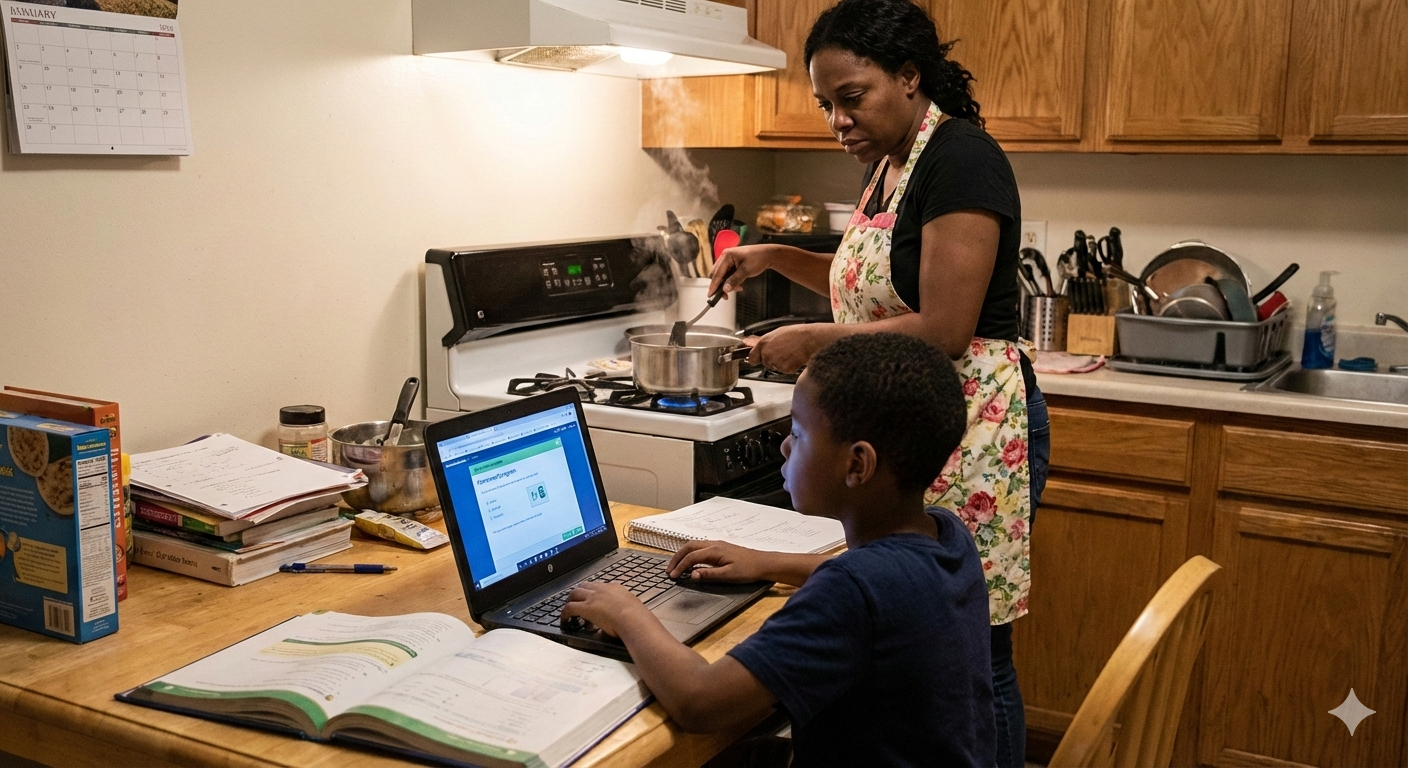
This lesson focuses on the "invisible architecture" of the household. It teaches that a home with a missing pillar (the father) often operates in a state of high vigilance.
• The HPA Axis & Chronic Stress: We explore the Hypothalamic-Pituitary-Adrenal (HPA) axis. In a single-parent home, the "background anxiety" of financial or emotional solo-parenting can lead to constant activation of this system, flooding the child’s developing brain with cortisol.
Get Started With Vision Bridge